Habitat in Nepal

The majestic Himalayan mountains draw us to this country
as we gather with other Habitat volunteers to build homes for the Nepali people.
Please return often to share the work with us.
______________________________________________________________________________

Sunday, October 3, 2010

DAY ONE at the worksite

The greetings and appreciation from locals for Habitat arriving here was overwhelming. As we stepped off the bus we saw a double line of locals stretching stretching hundreds of feet. Women in their native garb, and men and children, all expressing the warm Nepalese greeting, "Namaste". As we walked between the lines, most of us were choked with the emotion of their welcone.
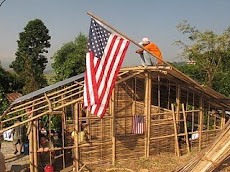
The 41 homes have been pre-built with foundations and the upright bamboo studs in place. We set up drillls and other tools to prepare and insert smaller posts in between and then begin weaving the "walls" with thin bamboo. Long day in very high temps, but our Kiwi construction leader, Glen, is pleased with the progress at end of day. "Same or better than most," he says.


Below:  Christy weaving the bamboo between upright bamboo poles. When all walls are completed in this manner, then a mortar covering will be troweled over and then painted.

Saturday, October 2, 2010

Habitat welcome

A very short flight late this morning brought us to Pokhara. Situated in the shadow of the big mountains, this city has a rural look with fields of rice and other grains. Our normal sized bus from the airport to the hotel negotiated very narrow roads, large and deep potholes, chickens and the occasional cow. At the end of long dirt lane, we arrived at the Fulbari Resort, our home for the week.

It is the women, carrying baskets with heavy loads on their backs,who frequently work the fields as they gather their crops.

In mid-afternoon we boarded another bus for the Himalayian Mountain Museum and the official welcome. Our team leader, Bob Bell (l) was excited to reconnect with his long-time Habitat friend, Aruna Paul (r), the head of Habitat Nepal. Also Nancy reconnected with Christine Odom from HFHI, who had been in Thailand last year, and was on duty now for the Build in Nepal.

Entertainment for the evening was a treat. Dancers performed traditional dances from a dozen different ethnic groups who call Nepal home. Tommorow will be first work day.


Friday, October 1, 2010

Hello luggage....

Another day, at the airport. but this time there is good news. Luggage finally arrived from Mumbai. Hooray! Now to can change out of the clothes we've been wearing for 3 days.

Tomorrow morning our team will be flying to Pokhara and the area of the worksite. Building begins the following day, Sunday. Everyone is excited.

Thursday, September 30, 2010

Thirty-seven hours to Nepal

Finally in Kathmandu, beautiful view of the mountains beyond a home flying prayer flags at rooftop. We're now meeting our team who are beginning to assemble here. The travel here was not seamless and we had a few bumps on the road getting here.

First, was before even leaving NJ as Nancy was 15 minutes down the road to meet Christy and realized that she forgot the credit cards for the trip and had to head back home to collect them.

After a 15-hour flight to Mumbai, we had an overnight layover. Since we had India visas, we left the airport for a modern, clean airport hotel. Hired a driver for 3 hours, 11pm-2am to explore the beach on the Arabian Sea and then refreshments at the Marriott there. What a contrast between the beach area for locals and the hotel, exclusive for foreigners only.

Next morning another bump as our driver took us to the wrong airport. With a great deal of angst and rushing around, we organized a "fast" driving cab to get this corrected. OK, all is well, we made it!

Arriving at Kathmandu, we waited long for our luggage, supposedly checked through from Newark. Our luggage did not get here. Last bump, we hope. Have to return to the airport next day (a 2-hour round trip) to collect luggage which hopefully, will arrive on next morning's flight.

Photo shows view of traffic here in the city of Kathmandu: everything moves slow, with vehicles so close that they are almost touching, and then, watch out and avoid locals cows who have right-of-way in roadway.

Sunday, September 26, 2010

Change hearts. Join hands. Build homes.

Only six words. But powerful ones. They were sent to us from Habitat for Humanity in Nepal in a message about the upcoming Build which begins on October 2nd.

“Volunteers are not the only ones looking forward to the start of Nepal Build. Habitat home partners are similarly excited. "Krishna Bahadur Pariyar expects the Nepal Build to help improve the economic situation of the families in the communities in Pokhara while Ramji Poudel likes the idea of building with bamboo which he says are “environmentally friendly and safer than concrete houses.”
Follow daily updates and photos here on this blog.

Tuesday, September 21, 2010

Leaving on a jet plane ...

Nine days to departure. This week we received our construction manual: thirty pages of how to build a bamboo house. The tools and equipment listed are mostly the standard drills, screw drivers, chisel, container for mixing mortar, etc. It is the materials list which gets interesting: different sizes of bamboo, bamboo nails, tin sheets (to make the roof), woven mat for ceiling and more.

And the instructions: which begin with a warning, "drilling holes in bamboo pieces should be done very carefully and precisely." Hmmm. Drawings, photos and text then show how to make walls, by weaving horizontal bamboo strips between the vertical bamboo posts and followed by brushing a slurry mixture of cement and water to fill in the gaps.

Not only do we have to figure out how to build in this manner, our team has to finish a complete house in one week. Enthusiasm coupled with quick learning and stamina will be the ticket for success. 

Of course, stamina will also be necessary for the week following when most of the teams venture onto the trekking trails in the Himalayas. Photo shows Nancy and Christy taking a break on a readiness hike up one of the NJ mountains ... just a little hill to anyone from Nepal :-)

Sunday, September 12, 2010

Where exactly is Nepal?

On a map of the world, Nepal is a small landlocked country of approximately 56,000 sq. miles, between two giants: India and China. It is a highly diverse land with a rich cultural history and magnificant geography extending from its lowlands to the majestic Mt. Everest at 29,000+ ft. This is where we will be working, in October....right in mid-country, nearby Pokhara, the second largest city and a bus ride away from the capital city of Kathmandu.

Thursday, September 9, 2010

September 2010

Getting ready. The countdown is on for Habitat for Humanity Nepal's Everest Build. Home partners are preparing the foundations of their houses and will be working side-by-side with the volunters during the Build Week beginning October 2nd.

The New Jersey contingent of Nancy (Paterson Habitat) and Christy (Morris County Habitat) will be joined by a dozen other Americans, including James who had worked with Nancy in Chaing Mai, Thailand on the Carter Build in 2009.

Sustainability is a by-word for today's times. This means environmentally friendly construction practices and use of natural materials available locally such as Nepal's bamboo. With a plentiful supply of strong fast-growing bamboo from forests in eastern Nepal, it will be used in the construction of the Habitat homes. What a learning experience for us. Interesting too!

BAMBOO FACTS:  Bamboo has been around for millions of years, and is the fastest growing plant on earth. In construction, it is typically considered to be a 'green' material because it is a rapidly renewable plant material. In fact, some bamboo can grow 18 inches per day, reaching a height of 100 feet, and generating more oxygen than an equivalent stand of trees.

Bamboo is twice as stable as oak, and harder than walnut and teak. In China, I have seen it used for scaffolding outside 7-story buildings. Bamboo’s tensile strength of 28,000 per square inch vs. 23,000 for steel makes it one of the strongest materials in the world.